
The administration of Bola Ahmed Tinubu is charting an ambitious path to reposition agriculture as the backbone of Nigeria’s economy, unveiling a sweeping package of reforms designed to boost food security, increase productivity, and stimulate inclusive growth.
At a time when rising food prices and supply challenges continue to test households across the country, the government’s renewed focus on agriculture signals both urgency and opportunity. From mechanization to financing and livestock development, the reforms reflect a multi-layered strategy aimed at transforming the sector into a modern, commercially viable engine of national development.
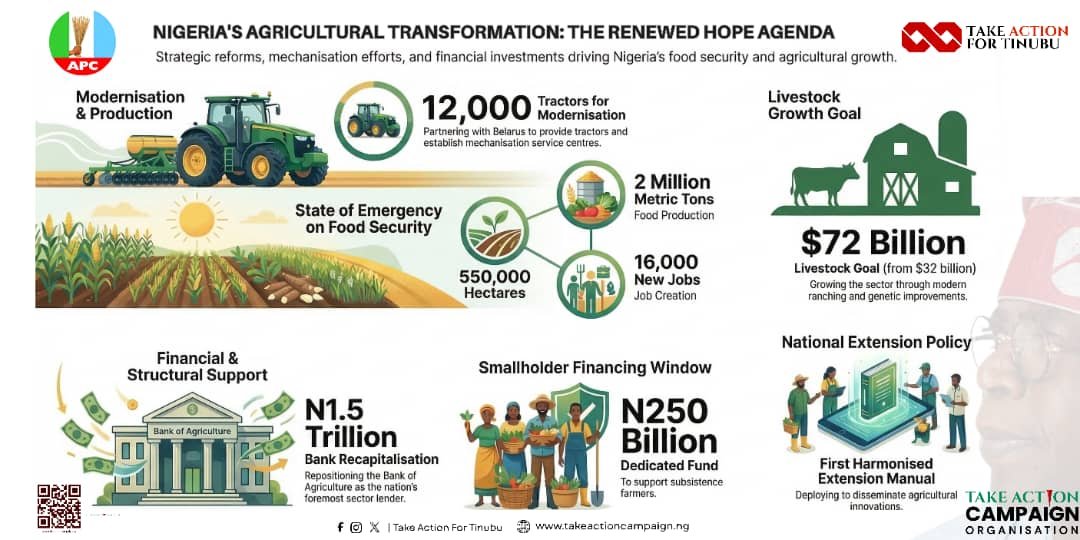
Central to this transformation is the push for mechanization and modernization. Under the Renewed Hope Agricultural Mechanization Programme, the Federal Government has begun deploying 2,000 tractors and accompanying implements to support smallholder farmers long considered the backbone of Nigeria’s food system.
The initiative seeks to replace labour-intensive practices with efficient, technology-driven methods capable of significantly improving yields.
This effort is further strengthened by a strategic partnership with Belarus, which will see the acquisition of 10,000 tractors over the next five years. Across the country, newly established Agricultural Mechanization Service Centres are providing farmers with access to affordable equipment, maintenance services, and technical expertise.
Beyond improving farm output, these centres are also expected to create jobs for young Nigerians while facilitating the transfer of modern agricultural technology.
Food security remains at the heart of the administration’s agenda.
In July 2023, President Tinubu declared a state of emergency on food security, underscoring the need for immediate and coordinated action. The plan targets the cultivation of more than 550,000 hectares of farmland, with an expected output of 2 million metric tonnes of staple foods and the creation of about 16,000 jobs.
Complementing this is the nationwide Dry Season Farming Initiative, which spans 500,000 hectares and aims to ensure year-round production.
By reducing dependence on seasonal rainfall, the programme is expected to stabilize food supply and cushion the impact of climate variability on farming communities.
In a bold policy shift, the administration has also turned its attention to livestock developmentan often underutilized but critical segment of the agricultural value chain. The creation of a dedicated Ministry of Livestock Development marks a new approach to managing the sector, with a focus on modern ranching practices, improved productivity, and conflict resolution.
The National Livestock Growth Acceleration Strategy outlines an ambitious target: expanding the sector’s value from $32 billion to $72 billion within a decade. To achieve this, the government is exploring partnerships with Türkiye to attract investment in red meat production, enhance livestock breeds through advanced genetics, and strengthen dairy output.
The broader goal is not only to improve nutrition and public health but also to address the long-standing farmer-herder conflicts that have disrupted rural livelihoods.
Financing, a long-standing constraint for farmers, is also receiving significant attention. The Federal Government has approved the recapitalization of the Bank of Agriculture with ₦1.5 trillion, positioning it to play a central role in funding agricultural expansion. In addition, a ₦250 billion financing window has been introduced to support smallholder farmers with accessible credit.
Through the National Agricultural Growth Scheme Agro-Pocket initiative, millions of farmers are gaining access to training, certified inputs, and irrigation equipment at subsidized rates interventions aimed at boosting both productivity and income.
The introduction of Nigeria’s first Harmonized Extension Manual, alongside a National Agricultural Extension Policy, further underscores the administration’s commitment to ensuring that innovation and best practices reach farmers at scale.
Taken together, these initiatives represent a comprehensive effort to transform agriculture from subsistence activity into a dynamic, market-driven sector.
While challenges remain, the Tinubu administration’s reforms offer a vision of a more resilient food system, one capable of feeding a growing population, creating jobs, and driving sustainable economic growth.
